Decision Literacy
How to think clearly, evaluate choices, and understand consequences.
Free and open educational curriculum
A free, open curriculum that teaches ages 8–12 how rules, contracts, and legal systems actually work.
18 core weeks, plus optional advanced weeks, designed for classrooms, homeschool families, after-school clubs, and any adult who wants to help kids move from seeing rules as arbitrary restrictions to understanding law as the operating system of society. Most weeks use two guided sessions and one independent practice, for about 60–90 minutes total.
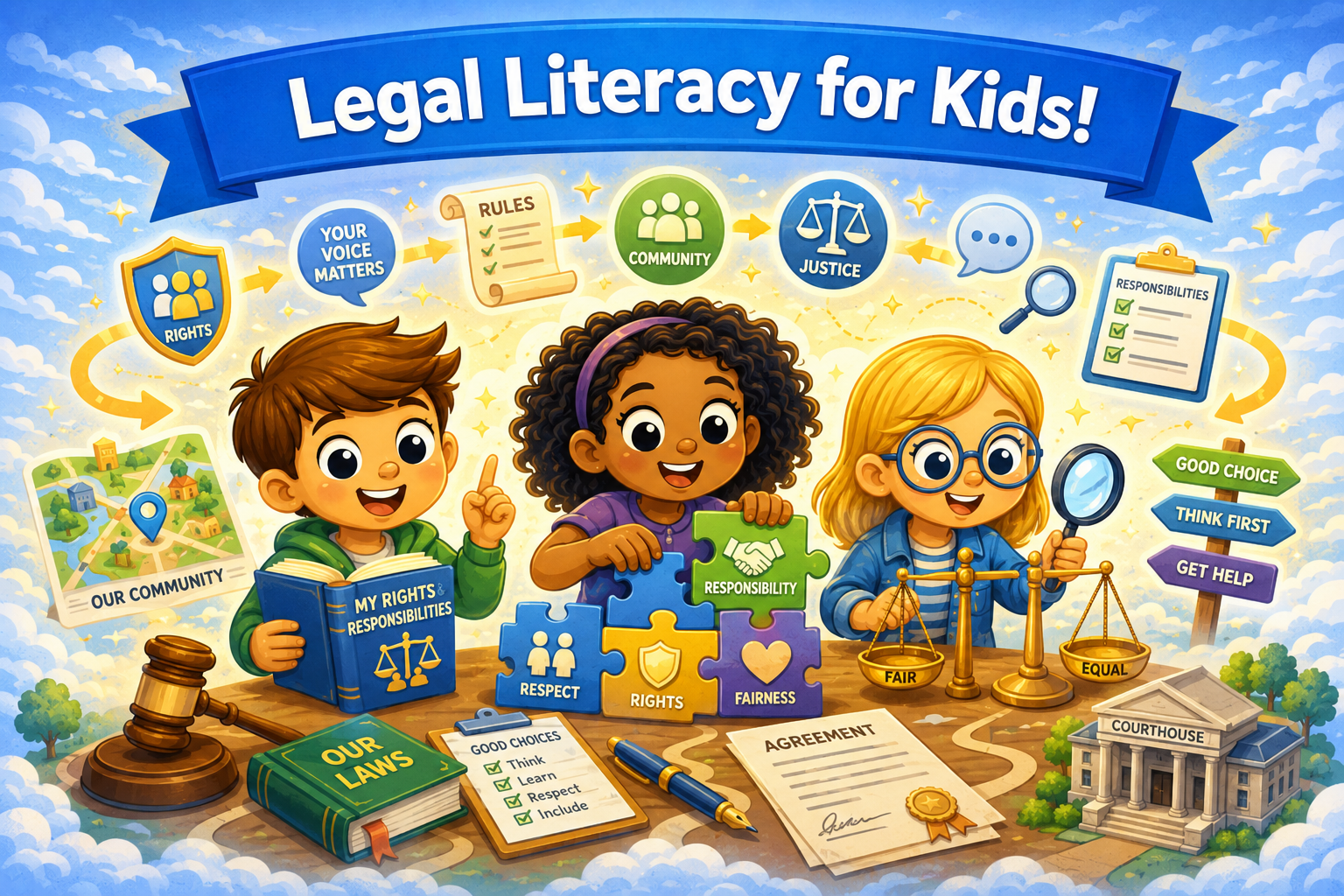
Legal Literacy for Kids is an 18-week core curriculum for ages 8–12, with optional advanced weeks, built for classroom teachers, homeschool families, caregivers, and after-school leaders. Students move from understanding why rules exist through contract writing, legal interpretation, and a full mock trial — learning to see law as the operating system of human society.
This curriculum is part of Literacy for Kids, a collection of open-source curricula designed to help children ages 8–12 understand the systems that shape the modern world.
How to think clearly, evaluate choices, and understand consequences.
How computers work and how to use technology responsibly.
How to find, interpret, and evaluate information.
How money and financial systems affect everyday life.
How societies organize themselves and how citizens shape communities.
How emotions, cognition, and social systems shape behavior and relationships.
How laws are built, how contracts work, and how disputes get resolved.
How planetary systems work and how human activity interfaces with them.
How the human body operates as an integrated system of feedback loops.
The curriculum is organized around mental models that help students transition from seeing rules as arbitrary restrictions to viewing them as structural engineering for group behavior.
Students contrast Rule of Law (predictable, objective) with Rule of Man (arbitrary) to understand why predictability allows societies to scale.
Students learn the anatomy of a promise: Offer (the input), Acceptance (the handshake), and Consideration (the payload/value exchanged).
Students learn how courts look at past decisions to patch bugs and update the law incrementally, ensuring forward compatibility.
Students explore the friction between what a rule says literally and what the system actually needs — identifying loopholes and bad incentives.
Rights are hardcoded boundaries — constraints on institutional power that prevent the network from overriding the individual node.
The learning progression moves from the theoretical need for rules through contract design, legal interpretation, rights and governance, and culminates in a full mock trial capstone.
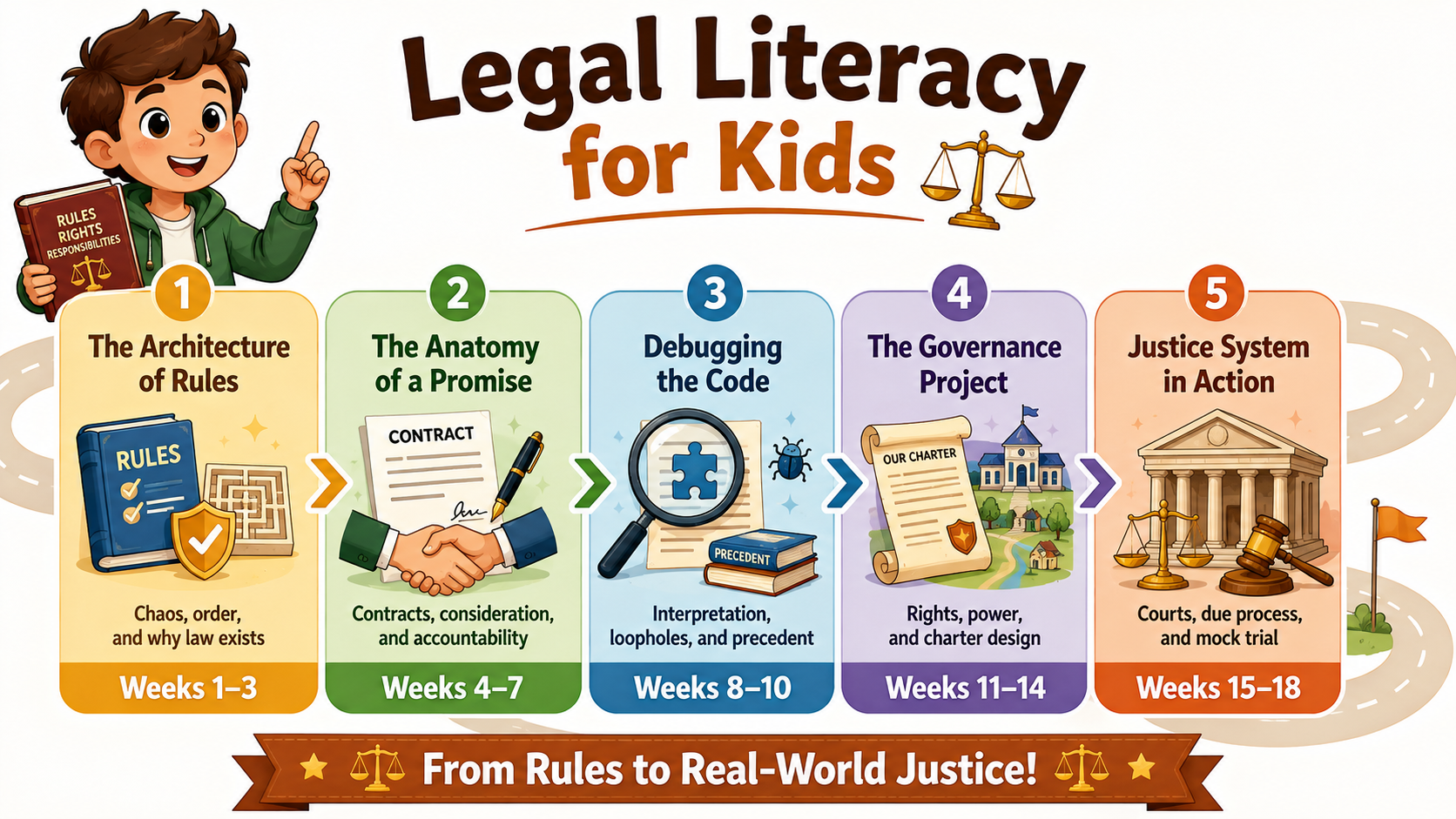
Weeks 1–3
Chaos, order, and the baseline need for law
Weeks 4–7
Contracts, consideration, and accountability
Weeks 8–10
Interpretation, loopholes, and precedent
Weeks 11–14
Rights, distributed power, and charter design
Weeks 15–18
Courts, due process, and mock proceedings
Begin with the Welcome page for an overview, then jump into Week 1. Each week includes two guided sessions and one independent practice. Younger learners may use 20-minute chunks; older learners often use 30-minute sessions.
Found a mistake or have a suggestion? Open an issue on GitHub.